Strange Bedfellows: Why Horror is a Natural Fit for 4K UHD & Blu-ray Physical Media
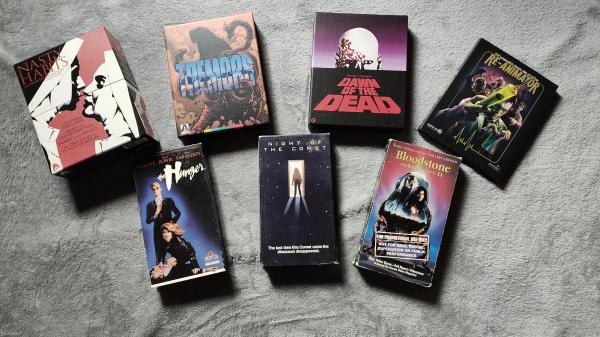
It's Friday night, 1995. Let the thought linger in your mind’s eye. Wandering a video store in the years before streaming was even a gleam in a technological giant’s eye. The bad carpet straight out of an office supply catalogue. The cardboard cutouts of new movies that have just come to videotape. The snacks. The gumball machine. Staring up at the shelves in the horror section, its VHS cover artwork splashed with blood, gore, and other nightmares come to life - rendered life, anyway, a facsimile of an oil painting that gave a visceral face to unspeakable terror. My mind always goes back to the poster artwork for The Company of Wolves, a horrifying image of a lycanthrope mid-transformation, the snout of a beast emerging from a human mouth. Physical media didn’t begin with horror, and it won’t end with horror, but the two have a certain kinship that feels indefinable. If you were to peruse the library of just about any collector, you’d find it stocked with titles of the macabre.
When video stores ruled the market, our conduit for bringing movies home with us, it gave movies that did so-so box office an opportunity to redeem themselves and have a second life. A movie like Re-Animator, which made a respectable $2m on a $1m budget during its theatrical run, couldn’t be rented fast enough. Stores had a difficult time keeping it in stock. It was checked out as soon as it was returned, barely lingering on the shelf long enough to cast a shadow. A movie like Tremors may not have broken any records at the cinema, but on home video, it was one of the most rented tapes of the year in 1990.
There was a whole slew of horror movies that were made directly for the home video market, saving money by being shot on 16mm instead of 35mm, because the larger film format wouldn’t be required. They would bypass the big screen and head straight to the small screen at the Ma & Pa video store near you. While direct-to-video was never solely reserved for horror movies, the format made sense for them. Whereas a comedy that went straight to video stunk of a studio dumping something they were ashamed of, hoping to recoup at least some of their investment. Horror movies were different. It’s been such a maligned genre for so long that its biggest fans knew the so-called dumping ground of direct-to-video releases said nothing about the film’s quality.
My adoration for physical media is twofold: Firstly, growing up, my mom managed a small-town video store, and my siblings and I had access to a wealth of weird and awesome stuff. We grew up with Full Moon Features because they were generous with sending screener tapes for the Subspecies series. Secondly, our neighbor and family friend had a bitchin’ home theater system and an in-home collection of videotapes. At nearly 40, I’ve come close to recapturing the awe and wonder of his setup, replete with surround sound, big-screen TV, and way more movies than I know what to do with.
Today, the home video market has changed entirely. Boutique labels like Arrow, Criterion, Shout!, and Vinegar Syndrome treat these once-frowned-upon flicks with the seriousness they’ve always deserved. Movies that were unceremoniously released, with middling reviews, but embraced by audiences on video, are receiving deluxe releases with thoughtful analyses in the form of essays and audio commentaries. As a reviewer for High-Def Digest, I’ve enjoyed hundreds of these releases, which contain thoughtful, academic-level explorations of themes and contextualize their history for modern viewers. I had the opportunity to interview some writers whose work I greatly admire, and ask them all the same basic question: Why do physical media and horror go together so well?
Kat Ellinger has contributed to supplemental features for such horror gems as Torso and Ms .45 from Arrow Video, and Second Sight’s release of Possession. The first release she ever contributed to was a booklet essay for Arrow Video’s release of Russ Meyer’s Beyond the Valley of the Dolls. I asked her why she thought physical media and horror go together so well.
“Watching at home, being able to pause and rewind the juicy bits, added in an extra level of forbidden fruit, which was entirely new at the time and therefore felt exciting and dangerous."
- Kat Ellinger

“I think it's a combination of things, really,” she said. “But I can only speak from a UK perspective. Home video really took hold during the period where slashers took off - and censorship was lessening year on year–and the new technology really opened the market to basically kids who were unable to see the films in theatres because of age restrictions but who (like most kids) wanted to watch the naughty stuff (not just the gore, but the sex, the drugs and all of that). For a start, many titles became forbidden in the UK because of the video nasties, which in turn built up a subculture for young people who were involved in tape trading networks and the like, trying to track down banned films. Some of those ‘kids’ went on to found home video labels themselves, like David Gregory at Severin. But outside of that, there were many films, including Eurohorror and American horror, which never came to theatres here, outside of places like London. We didn't have a grindhouse culture in the UK, or drive-ins (it rains all the time, so it wouldn't work). The only way to see many of these films was on tape.”
She continued, “Watching at home, being able to pause and rewind the juicy bits, added in an extra level of forbidden fruit, which was entirely new at the time and therefore felt exciting and dangerous. And of course, through that, we got a secondary network of direct-to-video horror, including SOV, which was again mainly targeted at young people. What that did, essentially, was create an entire community around the genre in a way that hadn't been seen before. Horror and porn were the two types of film that really saw an exponential growth under VHS and beyond--for obvious reasons--so horror has been wedded to the medium since it became common to have some sort of home video playback technology at home. While I loathe capitalism, we can thank savvy distributors for that!”
B.J. Colangelo also contributed to Arrow’s release of Ms .45, along with Kat Ellinger. BJ’s first contribution was for Vinegar Syndrome’s release of Scream, Queen: My Nightmare on Elm Street, an essay about the history of queerness in horror. When I asked her thoughts on physical media and horror, she said:
“Horror is so closely associated with uncontrollable feelings and physiological reactions that being able to 'capture' that sensation seems impossible. Cinema in general evokes a similar, almost-religious sensation, so having it ‘captured’ on a tangible piece of physical media feels equally impossible. At the same time, they're both constantly under attack. People are trying to convince us to disregard our physical media collections and give over to the ‘cloud,’ while horror is consistently viewed as lowest-common-denominator slop (it's not, but we all already know that). They go together because it's poetry.”

While reviewing Shudder’s A Wounded Fawn, I read a wonderful essay by Sabina Stent (she also contributed to Arrow’s release of Dark City) and was able to pick her brain. Her very first contribution was for Ocean Drive, as part of Indicator’s Columbia Noir #2 box set. She told me:
“I think physical media is so cherished for many reasons. There’s something reassuring about ready access to a film you love, especially one that has previously been out of print or is unavailable online, and you can access it at any time, unlike the precarious nature of streaming. The beauty of video stores was the discovery - of randomly selecting something you hadn't seen - and that film becoming a favorite. Some folks blind buy for similar reasons, and I do think ready access to video stores expanded our viewing habits - that and taping random films on VHS off the TV.”

I’ve written alongside Tori Potenza and Vannah Taylor at MovieJawn, and they’ve both contributed to Second Sight’s release of Ti West’s Pearl. The first release Tori was able to be a part of was for Assault! Jack the Ripper!, a Roman porno Japanese film from the 1980s. She agreed with much of what Kat had said, in reference to the UK’s war against the “video nasties”.
“I think the two work well together because, historically, horror has faced issues with distribution or censorship,” Tori began. She continued, “Thinking back to the times of Video Nasties in 80s UK, people were often making bootleg copies of films because there were no other ways to watch them, so if you were looking for what is subversive or blacklisted, physical media was what you relied on to find things. And today, with streamers that can be costly or can pull items from their catalogue, re-edit films, etc., physical media is still the saving grace of people trying to fight back against corporations or government bodies dictating what you are allowed to see and engage with. There is that Isaac Asimov quote, ‘Any book worth banning is a book worth reading.’ And I think it is the same with film and other mediums too. You should engage with banned media and ask why your government does not want you to see this. And because horror has often been the ugly stepchild of film (only slightly more palatable than porn), it makes sense that physical media is often the best way to find horror, especially if you are trying to find some of the real far-out-there stuff.”

"You should engage with banned media and ask why your government does not want you to see this."
- Tori Potenza
Pearl is Vannah’s first physical media writing assignment. When I asked her why she thought physical media and horror go together so well, she told me, “Horror has also been such a misunderstood genre, and paired with these releases is amazing editorial work and film analysis to shed new light on these genre pieces. I think it relates to the feeling that horror as a genre is something that has a cult following, if you will. Because of the long history of censorship, whether we are talking about the Hays Code or ‘video nasties,’ for a long time, so many things could only be seen if you knew someone who had a VHS tape you weren't supposed to watch. The tide has certainly changed lately, but whether a film had been pulled from theaters, snubbed by critics, or even stopped from getting any sort of official release, horror is something that weirdos like you and I had to go searching for. It makes sense that now the cinephiles behind these boutique labels are, in a way, paying homage to that by putting out these beautifully crafted releases. And in return, the rest of us are keen to continue our own love for scanning the shelves at the video store for our next new favorite horror flick by adding these physical releases to our collections. Once we have them in our hands, they can't be shelved by a distributor, cut for TV, or have their digital footprints wiped from streaming services.”

Samm Deighan recorded a commentary for the very first piece of physical media I ever reviewed, the woman-led spaghetti western The Belle Starr Story, for Moviejawn’s Disc Dispatch column. But the first piece of physical media she was involved in was writing an essay for Jose Larraz's gothic film Symptoms for Mondo Macabro almost a decade ago. Samm is unconvinced that horror is uniquely suited for physical media, any more than any other genre is, telling me, “I just think there are some people who feel passionate about that genre, who also enjoy collecting physical representations of their interests. I think some of it has to do with the fact that owning physical media allows you to rewatch your favorite movies (or new to you movies) without having to rely on streaming. And the more obscure your horror interests are, it's often the only way to see these films beyond bootlegs.”

Bill Hunt, founder and Editor in Chief of The Digital Bits, believes, “Horror is uniquely suited to a passionate diehard collector. Traditionally, horror has been a niche market, so the labels have been very good about going all out to deliver a serious enthusiast product. Now, a certain kind of horror is becoming a lot more mainstream. Anytime you go all out on quality and bonus content, that's a physical media winner.”
We all have a favorite piece in our collections, regardless of how rare or obscure it may be. There are some movies that people will buy whenever they’re re-released on a new format. I own Army of Darkness on VHS, DVD, Blu-ray and now 4K. I can’t seem to part ways with any of its “obsolete” versions. “Capturing” a film on such a tenuously tangible piece of physical media, to own it, as B.J.Colangelo put it, is something I’ve been fascinated by for ages. I still own my Bloodstone: Subspecies 2 screener tape, and it’s one of the darlings of my collection. One of the new items I cherish the most is Criterion’s now out-of-print Guillermo Del Toro trilogy, including Cronos, The Devil’s Backbone, and Pan’s Labyrinth.
I asked BJ what piece of physical media she owned and cherished the most, and she told me, “I have an old VHS tape of I Spit on Your Grave that I've had for over 20 years. It will probably be buried with me.”

Vannah Taylor had the opportunity to gush over her collection. She told me, “For a long time, I really cherished my DVD of 28 Days Later because for so long it was not streaming anywhere and it had not gotten its own boutique treatment yet, but my favorite DVD that I have is a fairly recent find: A cardboard digipak initial DVD release of House of 1000 Corpses, one of my favorite films of all time (that I for some reason didn't own any physical copies of until now...). The edges are slightly damaged, but that's expected since it has been floating around since 2003. I love finding older original releases, a little more exciting than reprints.”
Tori Potenza has a couple of favorites she wanted to call out: “Two come to mind that I would probably grab immediately if I had to flee my home; The Hitcher release from Second Sight, I love that movie and had been waiting on their remaster of it for ages. And the other, a Japanese VHS of David Cronenberg's Shivers that I found at a cool video pop-up event in Philly. The weird treasures you find while hunting for physical media are always the best.”


Kat Ellinger’s pride is in the hard work she’s put in for the discs she’s helped produce and get out there for all of us to cherish, love, and enjoy. She said, “I don't have any favorites, to be honest, but I do cherish some of the discs I've produced myself because I know the work that went into them behind the scenes, and they also represent chapters in my work and life. For example, the Arrow Coffin Joe and Gothic Fantastico sets, all of the Severin Danza Macabras, and then work I've done for Second Sight, like The Florida Project and Texas Chain Saw Massacre. All of these were fairly intensive long-term projects, so they inevitably took on a personal and emotional dimension for me, too.”
Samm Deighan’s cherished piece of physical media is a rarity, and even rarer to find in person. She said, “I feel like my answer should be related to something cool I've worked on (like the Arrow Shaw Brothers sets), but I have to go with the Blind Dead Collection DVD box set, which comes in a coffin. It was released probably 15 (or more?) years ago, and it took me forever to find it in the wild, which I finally did in a small shop in Milwaukee, somewhat recently. I doubt this series will ever get another box set this fun or cohesive.”

"Anytime you go all out on quality and bonus content, that's a physical media winner.”
- Bill Hunt
I often revisit the question I posed: Why do physical media and horror go together so well? And there’s no one answer. With physical media having gone through so many highs and lows, slumps and resurgences, people keep coming back to it because there’s a magic to it. Nothing will ever replace the cinema, but owning a movie allows you a familiarity with it. To have a sleepy-time favorite tape that you put on just before bed, and you can recite every line of dialogue, every musical cue, and every sound effect, is like a memory unto itself.
-
 Strange Bedfellows: Why Horror is a Natural Fit for 4K UHD & Blu-ray Physical MediaBy:
 -
 Turbine Is Back In Action for John Watts’ ‘Clown’ on 4KUHD Mediabook November 13th!By:
 -
 The Horror of 'Clown in a Cornfield' Comes Home With A 4K UHD SteelBook from RLJE Sept. 9th!By:
 -
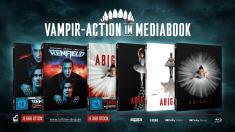 Turbine Sinks Their Fangs into Our Necks With NEW Renfield and Abigail 4K UHD Mediabooks!By: