| HIGH-DEF DISC NEWS TAGGED "OLIVER STONE" | Receive High-Def Disc News via RSS |
'Platoon' Blu-ray Bonus Clips
Fri May 20, 2011 at 09:00 AM ETTags: MGM/UA, Disc Announcements, Oliver Stone (all tags)
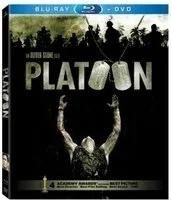
Oliver Stone's 1986 war epic is coming to Blu-ray next week. Full details and bonus clips are now available for this long-awaited release!
As previously reported, MGM/UA will be bringing 'Platoon,' featuring a young Charlie Sheen in his breakout performance, to Blu-ray on May 24.
The remastered, first-ever Blu-ray edition brings the sounds and images of Oliver Stone’s critically acclaimed Vietnam War drama to life in an entirely new way. 'Platoon' received eight Academy Award® nominations, winning four: Best Picture, Best Director, Best Sound and Best Film Editing. The all-star cast includes Sheen, Tom Berenger, Willem Dafoe, John C. McGinley, Forest Whitaker, Kevin Dillon, Keith David and Johnny Depp.
The release will be a Blu-ray/DVD combo pack with 1080p video, a DTS-HD Master Audio 5.1 soundtrack, and supplements will include: Audio Commentary with Director Oliver Stone; Audio Commentary with Military Advisor Dale Dye; Deleted & Extended Scenes; Flashback to Platoon (Snapshot in Time: 1967-1968, Creating the ‘Nam com and Raw Wounds: The Legacy of Platoon); One War, Many Stories; Preparing for ‘Nam; Vignettes (Caputo & The 7th Fleet, Dye Training Method, and Gordon Gekko); TV spots and theatrical trailer.
'Platoon' - Bonus Clip: "Relating to the Film"
'Platoon' - Film Clip: "This Is Hell"
'Platoon' - Film Clip: "Under Fire"
'Platoon' - Film Clip: "Helicopter Aid"
You can find the latest specs for 'Platoon' linked from our Blu-ray Release Schedule, where it is indexed under May 24.
See what people are saying about this story in our forums area, or check out other recent discussions.
- Discs mentioned in this article: (Click for specs and reviews)
- Platoon (Blu-ray)
The State of Blu-ray At CES 2011
Wed Jan 12, 2011 at 03:43 PM ETTags: Blu-ray Players, CES 2011, High-Def Retailing, Industry Trends, Baz Luhrmann, Michael Mann, Oliver Stone (all tags)
This year's CES was the first that didn't have Blu-ray players and Blu-ray discs featured as major releases. That's not necessarily a bad thing...
No matter how you got your CES - whether you read about it on High-Def Digest, watched snippets on TV, or went in person - you know that 3D was the big news of the show. Like it or not, it's what all of the major companies are pushing.
Some companies are making the 3D move more forcefully than others. Toshiba seems to be sitting on the fence between a few technologies, while Sony is putting everything it has into 3D, and 3D into everything it has.
With all the talk of 3D, it seems like Blu-ray got lost in the shuffle. There weren't any major Blu-ray player announcements and only one significant Blu-ray release was brought up at the show. You might even think of that as an ill-omen for the format, but it's exactly the opposite.
Before we talk about why Blu-ray didn't make the splash that it has in the last few years, I want to start with the big Blu-ray events of the show. The ones that were big enough to get picked up by mainstream sites and shows that don't specialize in Blu-ray coverage.
The biggest Blu-ray announcement at the show is something we already knew was in the works. Still, Panasonic held a bit of a ceremony to officially announce the upcoming release of the 'Star Wars' saga on Blu-ray disc.
This is huge. The original 'Star Wars' trilogy has been one of the most desired Blu-ray releases since the format was launched. Those three films are going to drive adoption of Blu-ray players to those who don't yet have them, make huge waves for Blu-ray sales numbers, and it's what's finally going to turn my dad into a Blu-ray fan.
You can criticize the release all you want, but even with the special editions of the original films and the inclusion of the second trilogy this is going to be one of the most successful Blu-ray sets of all time.
It's big news for fans and it's big news for the format. After all, now that Blu-ray has the biggest film trilogy ever made, there's not an obvious retort like "why would I buy a format that doesn't even have Star Wars?" It's a good get.
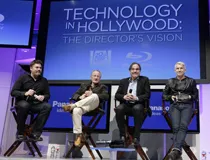
The second big Blu-ray event at the show was the Blu-ray director's panel, which I had the privilege of attending. It featured Baz Luhrmann, Michael Mann, and Oliver Stone talking about - you guessed it - Blu-ray.
It was a bit of a puff piece to be honest, but towards the end we started to get some really interesting insight into the way directors see the format. Opinions varied across the directors even though all three are fans of Blu-ray.
Oliver Stone, for example, said that he sees Blu-ray as the last bastion of movie preservation. It's possible that Blu-ray will be our final disc-based media format and that discs will one day be a thing of the past. For him, making a Blu-ray edition of his film is his chance to get the last word and finally close the book on his movies.
Baz Luhrmann is more optimistic about the future, but praises Blu-ray as the best way to reproduce video. For Baz, it's all about the colors that Blu-ray allows him to reproduce - something that DVD just couldn't do.
These were both significant events, and both made it to mainstream media, but neither made mention of Blu-ray players at all. Oliver Stone didn't sing the praises of a Panasonic player and Darth Vader - yes there was someone there in a Darth Vader costume - didn't plug any players either. It was all about movies.
The fact that no company felt the need to proselytize to the DVD crowd and sing the praises of the superior format seems strange considering the last few years, but it's a very good sign for Blu-ray.
Think of it in terms of 3D televisions. They're all the tech companies will talk about right now, and there's a reason for that. We're not buying them. Sure, 3D is selling, but it's not selling in the kinds of numbers that manufacturers want and the surefire way to improve that is to keep iterating, innovating and repeating the message.
The lack of huge Blu-ray player announcements and massive ad campaigns tells us more about Blu-ray adoption than any poll could. It shows that Blu-ray hasn't just been picked up by tech savvy consumers. The general public - the moms and dads of these tech savvy consumers - understand the benefit and are buying the players.
Think of the other technologies that were getting huge announcements in the last few years. LED backlit LCDs were shouted from the rooftops, but now they're a part of the HDTV environment just like 1080p, a 24Hz refresh rate for Blu-rays and even remote controls. We no longer have to decide if we support it or not - it's just there.
The other thing that I found incredibly telling about the lack of big Blu-ray player announcements was the lack of crazy new Blu-ray players. It seems like innovation has settled down for the format, and now the battle of cost efficiency and design has begun.
After all, you can pick up a Blu-ray player that handles 3D, streams Netflix with built-in WiFi and even plays back media files from your computer for under $200. What more could you want?
Sure, there were a few new things, like portable players, those with built-in glasses-free 3D screens and those packing Google TV. For the most part though, it seems like Blu-ray players have stabilized. Most of the new players on the market offer the same features in a different package, just like DVD players before them.
Every year since the release of the format has been hailed as "the year of Blu-ray," but really 2011 seems to be it. It's the year we finally stopped making a big deal out of the hardware, got everything right, and started talking about what matters most - the movies.
- Dick Ward
See what people are saying about this story in our forums area, or check out other recent discussions.
Blu-ray Director’s Panel – CES 2011
Sun Jan 09, 2011 at 03:04 AM ETTags: CES 2011, Panasonic, Blu-ray, Michael Mann, Baz Luhrmann, Oliver Stone (all tags)
Baz Luhrmann, Michael Mann and Oliver Stone sit down to talk about how they see the Blu-ray format and how the adaption of Blu-ray changes the way they make movies.
I’m sitting in one of forty seats reserved for the CES directors panel and I’m surrounded by other press members as well as executives from Fox Home Entertainment. Around our stadium seats, a crowd gather to get a chance to hear from some of the greats.
After a quick introduction, Jeff Bucher of the L.A. Times brings out Michael Mann, Oliver Stone and Baz Luhrmann, who take their seats on director’s chairs that don’t actually seem that practical. Mann sits in his comfortable, but Stone‘s feet dangle and Baz simply leans on his. Their seating style reflects their character too, with Baz playing up the crown and Stone seeming like he’d prefer a one-on-one to a crowd.
Bucher starts off with a question for all the directors, and it’s just what you’d expect from a Blu-ray panel sponsored by Panasonic. “What does Blu-ray mean to you, and what excited you when you consider the format?
Mann takes the first crack at the question. He says that the high-definition picture of Blu-ray really helps to pay off the work that directors do on the films. “The attention to detail, the color, how dense we want a background to be with extras,” he says, are all things that come into consideration.
“It’s like having a print at home,” says Oliver Stone. “Not only is it like a print at home, but it’s actually usually better than the old print. Criterion Classics is great, but a Blu-ray compared to it – there’s just no comparison.”
Luhrmann briefly touches on how much he would enjoy having Orson Welles commentary on one of his films and then says, matter-of-factly, “Blu-ray for me, it’s better,” to a laugh from the crowd.
He says that when he made his trilogy of films, the goal was to reproduce three strip MGM Technicolor, and they were unable to do it. When the films were redone for Blu-ray, colorist Jan Yarbrough spent around 1,000 hours rebuilding a tri-color look. Baz suggests that if you want to see ‘Romeo + Juliet’ or ‘Moulin Rouge’ as he intended then “please go out and buy the newly released Blu-rays.”
We’re treated to a clip from ‘Romeo + Juliet’ that shows off the color reproduction of the Blu-ray format which has Baz half-jokingly suggesting that “I think the reds still need a minor adjustment – just one more tweak and I’ll be done!”
Introducing the next clip – the Elephant Love Medley from ‘Moulin Rouge’ – Baz explains that the movie grew from a love of musicals as a child. He set out to recreate the magic with a combination of new techniques and old techniques.”
“When you’re making a film now,” asks Bucher of Baz, “how far into it do you start thinking about the Blu-ray release.”
“That really has changed,” says Baz. “I’ve always been a DVD, and now Blu-ray, nut. I think you can have a relationship with a film and want to know more about it.” He says that the Blu-ray can dramatically improve that relationship if it’s done right.
He talks about the Blu-ray extras like behind-the-scenes footage and commentaries with a twinkle in his eye. It’s clear that not only does he love putting his movies on Blu-ray, but he loves watching all those special features on other films too.
The focus shifts to Oliver Stone as Bucher shows a few clips from both the classic ‘Wall Street’ and the new movie ‘Wall Street: Money Never Sleeps.’
The clips end to applause and Bucher moves away from the subject of Blu-ray briefly to ask Stone what it was like going back to a film for a sequel so long after its initial release. “It’s the best experience you can have. I would suggest that you don’t do any sequels for 23 years.”
“As Baz says, there’s too much light in the room, but you can really see the water, the fog in the air and the atmosphere in this movie. It’s a classic one-time experience and you don’t get that on anything else but Blu-ray.”
Bucher says that during a conversation back stage, Stone was ecstatic when talking about color reproduction.
“Every director has their thing,” says Stone, “and for me it’s color. Baz is a color freak I can tell, but I love color. I love reds and greens and [to Baz] your blues are beautiful.” He says that even in the brown and tan atmosphere of the original ‘Wall Street,’ colors reproduction is absolutely essential for communicating the mood and character of the film.
“Some people don’t like doing it, but how do you feel about director’s commentary,” asks Bucher. “Is that something that appeals to you?”
Stone says that he feels that it’s your last opportunity as a director to make the point you were trying to make with your film and to get the vision across to the audience. “I put my heart into it, I always do.
We then move on to Michael Mann, who introduces a clip from ‘Last of the Mohicans.’ He says that the real challenge in the movie was to sell the audience on the location and the authenticity of the environment, from the accuracy of the clothing to the vast expanses of land.
“It seems to me,” suggests Bucher, “that the vistas and cliffs aren’t just background, but a character.”
“It all had to do with the detail. Visually, we’re all smarter than we thing we are,” says Mann. He says that authenticity is one of the most essential parts of the film for the audience and the actors alike.
“We did everything, down to the braiding of an officer’s coat,” he says. He says that’s the kind of thing you couldn’t’ see on DVD but it finally pays off on Blu-ray.
“In this day and age, you can watch a movie on a telephone,” says Bucher. “Then there are movie theaters where the lighting isn’t right and screens that aren’t optimized. I’d imagine Blu-ray helps you keep some of that control. Do you find it satisfying to go back to a movie and put in on Blu-ray?”
“I take every opportunity to go back and fix this mistake and that mistake, I really do,” says Mann.
“Do you feel a sense of optimism about the future, or do you think it’s going to be problematic keeping up with everything and still telling a good story?” asks Bucher.
“Watching my children and friends multitask through a movie with the lights on is very depressing to people like me,” says Stone. “This is a moment in time about film preservation. This takes the old films and preserves it in a form that’s the best of the last hardware… You’ll never have access to a hard copy of these movies after Blu-ray.”
“I remember when baseball cards were on the way out and now they’re worth more today than they ever were when I was a kid,” he adds. “Keep on collecting Blu-rays, I think that’ll be an investment that pays off in 2050.”
Baz has a different attitude from Mann and Stone. “The power of the instrument is so great that I’m conscious about misusing it.” He says that some movies become amazing Blu-rays and are enhanced by the innovation. Others “are like friends that had too much plastic surgery and they come out looking completely different.”
He also says that you have to be careful when restoring works that the directors aren’t around to work on. His colorist was working on the ‘Wizard of Oz’ Blu-ray and when the higher resolution revealed details not originally present in the film, a decision had to be made about what to do with it.
The final word on film restoration, and the final word of the panel, comes from Baz. “Are we trying to recreate the film or are we trying to recreate your memory and your experience?”
See what people are saying about this story in our forums area, or check out other recent discussions.
Blu-ray Director’s Panel – CES 2011
Sun Jan 09, 2011 at 03:04 AM ETTags: CES 2011, Panasonic, Blu-ray, Michael Mann, Baz Luhrmann, Oliver Stone (all tags)
Baz Luhrmann, Michael Mann and Oliver Stone sit down to talk about how they see the Blu-ray format and how the adaption of Blu-ray changes the way they make movies.
I’m sitting in one of forty seats reserved for the CES directors panel and I’m surrounded by other press members as well as executives from Fox Home Entertainment. Around our stadium seats, a crowd gather to get a chance to hear from some of the greats.
After a quick introduction, Jeff Bucher of the L.A. Times brings out Michael Mann, Oliver Stone and Baz Luhrmann, who take their seats on director’s chairs that don’t actually seem that practical. Mann sits in his comfortable, but Stone‘s feet dangle and Baz simply leans on his. Their seating style reflects their character too, with Baz playing up the crown and Stone seeming like he’d prefer a one-on-one to a crowd.
Bucher starts off with a question for all the directors, and it’s just what you’d expect from a Blu-ray panel sponsored by Panasonic. “What does Blu-ray mean to you, and what excited you when you consider the format?
Mann takes the first crack at the question. He says that the high-definition picture of Blu-ray really helps to pay off the work that directors do on the films. “The attention to detail, the color, how dense we want a background to be with extras,” he says, are all things that come into consideration.
“It’s like having a print at home,” says Oliver Stone. “Not only is it like a print at home, but it’s actually usually better than the old print. Criterion Classics is great, but a Blu-ray compared to it – there’s just no comparison.”
Luhrmann briefly touches on how much he would enjoy having Orson Welles commentary on one of his films and then says, matter-of-factly, “Blu-ray for me, it’s better,” to a laugh from the crowd.
He says that when he made his trilogy of films, the goal was to reproduce three strip MGM Technicolor, and they were unable to do it. When the films were redone for Blu-ray, colorist Jan Yarbrough spent around 1,000 hours rebuilding a tri-color look. Baz suggests that if you want to see ‘Romeo + Juliet’ or ‘Moulin Rouge’ as he intended then “please go out and buy the newly released Blu-rays.”
We’re treated to a clip from ‘Romeo + Juliet’ that shows off the color reproduction of the Blu-ray format which has Baz half-jokingly suggesting that “I think the reds still need a minor adjustment – just one more tweak and I’ll be done!”
Introducing the next clip – the Elephant Love Medley from ‘Moulin Rouge’ – Baz explains that the movie grew from a love of musicals as a child. He set out to recreate the magic with a combination of new techniques and old techniques.”
“When you’re making a film now,” asks Bucher of Baz, “how far into it do you start thinking about the Blu-ray release.”
“That really has changed,” says Baz. “I’ve always been a DVD, and now Blu-ray, nut. I think you can have a relationship with a film and want to know more about it.” He says that the Blu-ray can dramatically improve that relationship if it’s done right.
He talks about the Blu-ray extras like behind-the-scenes footage and commentaries with a twinkle in his eye. It’s clear that not only does he love putting his movies on Blu-ray, but he loves watching all those special features on other films too.
The focus shifts to Oliver Stone as Bucher shows a few clips from both the classic ‘Wall Street’ and the new movie ‘Wall Street: Money Never Sleeps.’
The clips end to applause and Bucher moves away from the subject of Blu-ray briefly to ask Stone what it was like going back to a film for a sequel so long after its initial release. “It’s the best experience you can have. I would suggest that you don’t do any sequels for 23 years.”
“As Baz says, there’s too much light in the room, but you can really see the water, the fog in the air and the atmosphere in this movie. It’s a classic one-time experience and you don’t get that on anything else but Blu-ray.”
Bucher says that during a conversation back stage, Stone was ecstatic when talking about color reproduction.
“Every director has their thing,” says Stone, “and for me it’s color. Baz is a color freak I can tell, but I love color. I love reds and greens and [to Baz] your blues are beautiful.” He says that even in the brown and tan atmosphere of the original ‘Wall Street,’ colors reproduction is absolutely essential for communicating the mood and character of the film.
“Some people don’t like doing it, but how do you feel about director’s commentary,” asks Bucher. “Is that something that appeals to you?”
Stone says that he feels that it’s your last opportunity as a director to make the point you were trying to make with your film and to get the vision across to the audience. “I put my heart into it, I always do.
We then move on to Michael Mann, who introduces a clip from ‘Last of the Mohicans.’ He says that the real challenge in the movie was to sell the audience on the location and the authenticity of the environment, from the accuracy of the clothing to the vast expanses of land.
“It seems to me,” suggests Bucher, “that the vistas and cliffs aren’t just background, but a character.”
“It all had to do with the detail. Visually, we’re all smarter than we thing we are,” says Mann. He says that authenticity is one of the most essential parts of the film for the audience and the actors alike.
“We did everything, down to the braiding of an officer’s coat,” he says. He says that’s the kind of thing you couldn’t’ see on DVD but it finally pays off on Blu-ray.
“In this day and age, you can watch a movie on a telephone,” says Bucher. “Then there are movie theaters where the lighting isn’t right and screens that aren’t optimized. I’d imagine Blu-ray helps you keep some of that control. Do you find it satisfying to go back to a movie and put in on Blu-ray?”
“I take every opportunity to go back and fix this mistake and that mistake, I really do,” says Mann.
“Do you feel a sense of optimism about the future, or do you think it’s going to be problematic keeping up with everything and still telling a good story?” asks Bucher.
“Watching my children and friends multitask through a movie with the lights on is very depressing to people like me,” says Stone. “This is a moment in time about film preservation. This takes the old films and preserves it in a form that’s the best of the last hardware… You’ll never have access to a hard copy of these movies after Blu-ray.”
“I remember when baseball cards were on the way out and now they’re worth more today than they ever were when I was a kid,” he adds. “Keep on collecting Blu-rays, I think that’ll be an investment that pays off in 2050.”
Baz has a different attitude from Mann and Stone. “The power of the instrument is so great that I’m conscious about misusing it.” He says that some movies become amazing Blu-rays and are enhanced by the innovation. Others “are like friends that had too much plastic surgery and they come out looking completely different.”
He also says that you have to be careful when restoring works that the directors aren’t around to work on. His colorist was working on the ‘Wizard of Oz’ Blu-ray and when the higher resolution revealed details not originally present in the film, a decision had to be made about what to do with it.
The final word on film restoration, and the final word of the panel, comes from Baz. “Are we trying to recreate the film or are we trying to recreate your memory and your experience?”
See what people are saying about this story in our forums area, or check out other recent discussions.